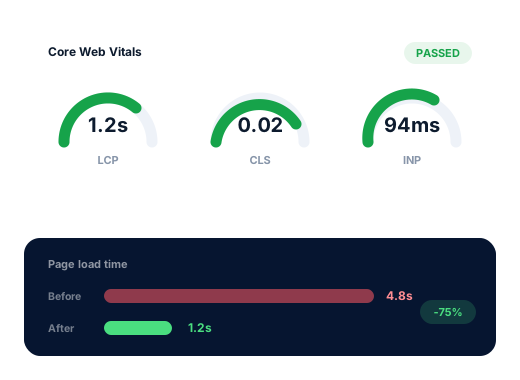
Largest Contentful Paint (LCP)
LoadingWhen the biggest thing on screen, usually the hero photo, has finished drawing. The target is 2.5 seconds or less. This is especially where photo-led sites run into trouble.

Speed Optimization
Speed optimization for Calabasas businesses whose sites lean on photography, from listings and venues to treatment rooms and finished projects, measured the way customers open them: on a phone, often from the car.

Businesses in Calabasas often sell with images. A hillside listing needs its pool terrace and canyon view, a ranch venue needs its oaks at dusk, a med spa needs its treatment room, and a remodeler needs the finished kitchen. Those photos tend to arrive straight from a professional camera at full size and get placed on the page as they are. On an office computer with fast internet the result looks fine, but on a phone it can take long enough that the visitor gives up.
In fact, most first visits do happen on a phone. Calabasas is a driving city, so people search from the passenger seat, from a parking space near The Commons or from the edge of a playing field on a Saturday. Searches like “calabasas restaurants near me” and “calabasas luxury homes for sale” are typed with a thumb, and the person on the other end taps back to the results if your page is still blank.
Speed also feeds Google’s judgment. According to Google’s Core Web Vitals page, its ranking systems use loading data gathered from real Chrome users, so a sluggish site loses twice: fewer visitors stay, and Google sees less reason to rank it. Good speed optimization rarely cuts photos; instead, it fixes their dimensions, their file format and the order in which they load.
Search demand
These October 2026 Google suggestions, collected with US settings, never mention site speed; instead, they are the phrases that send people on phones to the most photo-heavy pages a local business has.
You do not have to give up the pictures that sell your work. A hero image sized for the screen it appears on, saved as WebP or AVIF, and given priority while the gallery beneath waits for the visitor to scroll, can look identical and arrive far sooner. So our speed optimization starts with the pages that matter most, usually the listing, gallery or menu, and aims for a pass in Google’s real-visitor data rather than a perfect lab score.
Usual suspects
A slow site rarely has a single cause, so expect several of these at once.
A straight-from-the-camera photo can weigh more than everything else on the page put together, even when it ends up shown at thumbnail width. So we scale it to the space it fills and save it in a newer format, which removes most of that bulk.
A home page carousel with twelve full-size photos makes the phone fetch all twelve before the first one settles. So loading only what is on screen, and the rest on demand, fixes it.
An autoplaying drone clip of the hills can look striking, but on mobile data it can hold up everything else. A still image, or a video that plays only when tapped, is usually the better trade.
Drag-and-drop builders often load a large bundle of scripts and styles on every page, even when that page uses none of them.
When the server is slow to send its first byte, every later step starts late. Caching can mask some of it, and occasionally moving host is the only real cure.
The three measurements
The figures come from actual visitors using Chrome, pooled over four weeks. To pass, three out of four of those visits have to clear each line.
When the biggest thing on screen, usually the hero photo, has finished drawing. The target is 2.5 seconds or less. This is especially where photo-led sites run into trouble.
How long the page takes to react after a tap, such as opening a gallery or a menu. The target is 200 milliseconds or less. However, heavy sliders, chat tools and stacks of tracking tags slow it down.
Measures how far things move about as the page fills in, the reason someone taps “Book” and lands on “Call”. A score under 0.1 passes; we get there by holding space open for images, banners and booking widgets before they arrive.
The work
We log current mobile scores, real-visitor data and page weights for your most visited pages before touching anything.
Every image scaled to the size it is shown at, compressed, served as WebP or AVIF where browsers accept it, and loaded only as the visitor approaches it.
The first photo is given priority, while the rest are fetched as people scroll or swipe, with space held open so nothing jumps.
Chat bubbles, review widgets and analytics tags are delayed until the page is usable, and plugins that do nothing are deleted.
Server and browser caching tuned to your hosting, as well as a content delivery network where it pays off.
A second round of measurements on the day changes go live, and another after four weeks, when the field data has caught up.
Done carefully
House rules for every Calabasas client, set out here so you can check us against them.
Fast pages stop people leaving early. Whether they then pick you, however, rests on your portfolio, your reviews and what your pages actually say.
Google treats page experience as one factor among many, so we describe it that way. When your pages pass, we stop and tell you, and then point to work that would help more, such as stronger service pages or your Business Profile. Speed optimization is quoted once, after an audit, as a one-time job.
Ask us about your business
How we work
The same four stages for every Calabasas client, whatever the trade.
An audit of your site and map listing, with rankings sampled from Old Town, the hills above it and nearby towns.
We pick the phrases worth owning and give each one a single page with a clear purpose.
Profile, site, content and listing changes, beginning with whatever should move inquiries soonest.
Each month, a brief summary of leads and positions, plus what we tackle next.
Questions
Two quick checks. First, Google’s free PageSpeed Insights tool, looking at the mobile tab and the section based on real visitors. Second, your own phone: switch off wifi, close the browser, and open your home page and your busiest gallery as a stranger would.
Rarely. Most galleries can keep every image if each one is resized, compressed and loaded only when the visitor reaches it. We may suggest dropping near-duplicates, but the choice stays with you.
Sometimes, at the margin, when two businesses are otherwise evenly matched. The surer return is behavioral: people who see the page quickly are more likely to read on and get in touch.
Not necessarily. We can swap autoplay for a still image that plays the video on request, or serve a lighter version to phones. So you keep the mood without the wait.
On a small site, the fixes usually fill one or two weeks, but Google’s field report averages four weeks of fresh visits, so the official verdict arrives about a month after the work is done.
A single fixed price, set when an audit has found the causes. After that, staying quick is part of the regular care in every monthly plan, from $250 (Starter) through $350 (Growth) to $550 (Pro), in US dollars.
Further reading
Related articles for Calabasas owners who want to go deeper on this topic.
Any of these can be hired alone; many Calabasas clients begin with just one.
Buyers in each of these fields use different words, so every page draws on separate research.
A free look at how you rank from Old Town to Mont Calabasas, which firms sit above you and which repairs would count most.
Request my free audit